Numbers indicate that companies overspend on information management
There’s good news and bad news in Paul Strassmann’s forthcoming book, Information Productivity. The good news is that during the past 10 years, U.S. industrial corporations have lowered the ratio of information management costs to operating profits and net assets. The bad news is that the country’s largest companies fall far short of using technology to maximize profits.
Strassmann, former CIO at General Foods and Kraft, is a consultant who specializes in measuring the effectiveness (or ineffectiveness) of information management. His book is based on his analysis of financial disclosures by 10,593 publicly traded industrial corporations. Private companies are not included. Also missing are banking, insurance, real estate, and medical services enterprises because their financial structure is materially different from that of industrial companies.
It’s difficult to disagree with Strassmann’s conclusions because they’re so data intensive, but it’s also difficult to totally agree with them because numbers alone don’t convey a complete picture. As columnist Bob Lewis wrote of Strassmann’s previous book, The Squandered Computer, “… collecting facts and drawing proper inferences are two different matters.” (See “For a clearer picture of its value, get to know those who use the equipment.”)
Our research expert, Senior Associate Editor Jim Battey, points out that “information management” is not the same as IT management. Strassmann defines information management expenses as the sum of sales, general, and administrative, plus research and development expenses – commonly known as overhead costs.
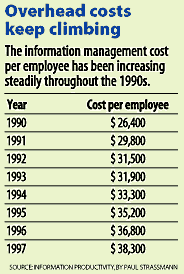
The fact that the amount spent on information management keeps rising, Strassmann contends, is bad because as fixed costs increase, the break-even level for business operations increases with it.
By Strassmann’s calculations, 55 percent of the U.S. workforce is employed in occupations that are almost exclusively engaged in information processing, coordination, creation, and distribution – all of which add up to the information economy.
As a result, Strassmann says, “the effectiveness in deploying information resources has potentially a greater effect on corporate financial performance than any other economic influence. That is because corporate executives have greater discretion in directing what their information management staffs will do than in setting the terms for materials purchase, employee compensation, taxes, or interest rates.”
And corporate executives are doing a bad job of managing information resources, he says. During the 1990s, the cumulative increase in the information management cost per employee was 57.9 percent, compared with gains in employee wages and salaries of only 40.5 percent.
The culprits, Strassmann claims, are big companies. A mere 108 companies that employ more than 50,000 people account for nearly 43 percent of the $1.05 trillion spent on information management. By contrast, 1,040 companies with 5,000 to 10,000 employees spend a total of $96 million, or about 9 percent.
According to Strassmann’s Web site (www.strassmann.com), Information Productivity is scheduled to be released in June, 1999. The listed pre-publication price is $69, plus shipping and handling.
Editor in Chief Sandy Reed has been following the high-tech industry as a journalist for 15 years. Send comments to sandy_reed@infoworld.com.