Interested in this article?
For reprints contact:
bkerber@cio.com

The Hall of Fame...
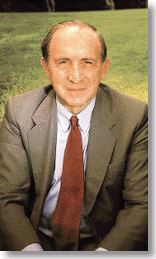
Paul A. Strassmann
DuWayne J. Peterson
Cinda A. Hallman
David V. Evans
Max D. Hopper
Ron J. Ponder
Katherine M. Hudson
Charles Feld
Patricia M. Wallington
John Cross
Bob L. Martin
Donald R. Lasher
Finding
it Online
Strassmann Inc.
(
http://www.strassmann.com/)

|
Career Highlights
|
Today: |
President, The Information Economics Press, New Canaan, Conn.; author; adjunct
professor, National Defense University in Washington and the U.S. Military
Academy at West Point |
|
1991-93: |
Director of defense information, U.S. Department of Defense |
|
1978-85: |
Vice president of strategic planning, Xerox Corp. |
|
1969-78: |
Several positions, including corporate director of worldwide computing,
Xerox Corp. |
|
1960-69: |
Corporate information officer, General Foods and later Kraft |
|
Education: |
Bachelor's degree in engineering from Cooper Union; master's degree in
industrial management from MIT |
|
Books: |
Include Information Payoff: The Transformation of Work in the Electronic
Age (1985), The Business Value of Computers (1990), and The Politics of
Information Management (1993), all published by The Information Economics
Press |
Certainly more than any other CIO on this list, Paul Strassmann
invites controversy. His aggressive critiques of conventional notions of
IT payoff, and statements like, "there's no correlation between IT and
profitability," tick a lot of people off. "Paul has consistently challenged
the sometimes unsubstantiated hype in this industry, particularly in areas
of productivity," says James Sutter, vice president and general manager of
Rockwell Information Systems, who worked for Strassmann at Xerox. "People
with favorite ideas and projects would find him challenging them, and that's
made him unpopular in some cases."
Strassmann's actions as IS chief at Xerox and later the Department
of Defense, along with his books, have hammered home his assertion that
one cannot prove the value of technology using the size of the IT budget
or any other technical metric. Only business measurements--tied right to
shareholder value--can prove IT's worth. By and large, CIOs have heard
Strassmann's call over the past 10 years, and now even most trade magazines
don't judge the excellence of an IT department by how much it spends. But
Strassmann knows his message hasn't reached everyone. "Sometimes I'm not
even sure my wife hears me," he says.
Indeed, Strassmann's Value of IT model, which links IT to specific
business value, sometimes sails over the heads of his audience. "His model
and writings do not always get acceptance--even from the financial area
of the firm," says James R. Kinney, vice president and CIO at Kraft Foods
and president of the Society for Information Management International. "A
Fortune 50 company tried to use his material and, though their CFO accepted
it, general management was befuddled. I think one of the reasons is that
general managers are not always that well versed in the economic structure
of the firm to begin with."
Despite his emphasis on business economics, it's the nonprofit
public sector that is the setting for Strassmann's most gratifying
contribution. "When I got to the Pentagon, I basically had a checkbook
from the secretary [of defense], so all of the people in the DOD came to
me in the first week to make presentations for their projects," Strassmann
recalls. "They had more flip charts and more books and more slides than
I could ever possibly see. So I had some hotshot guys program Chapters
9 and 10 from my 1990 book, which defined how to do business value
assessment." Strassmann told the DOD supplicants to run their numbers
through the program, then come back and talk. As one might expect, this
thinned their ranks considerably.
The program eventually was published on CD-ROM, and 11,000 copies
were distributed throughout the federal government, earning recognition from
Vice President Gore's Reinventing Government group. Last year, a civilian
version was produced. Quips Strassmann, "Now you've got Strassmann in a can."
Chris Hoenig, director of the information management and technology
issues of the U.S. General Accounting Office, views Strassmann as a pioneer
in the public sector. "Paul was influential because he tried to create
serious change by applying leading practices from the private sector to
government," Hoenig says. "He tried to set a new standard, and we really
learned a lot from his courageous efforts."
- Richard Pastore
Photo by Edward Santalone

CIO Magazine - September 15, 1997
© 1997 CIO Communications, Inc.
http://www.cio.com/archive/091597_strassman.html
|
|
|